November 28, 2026
Riad Wood Restoration: Cedar Ceilings and Beeswax
Riad wood restoration requires stabilizing historical architectural elements through precision joinery, moisture-controlled timber, and breathable
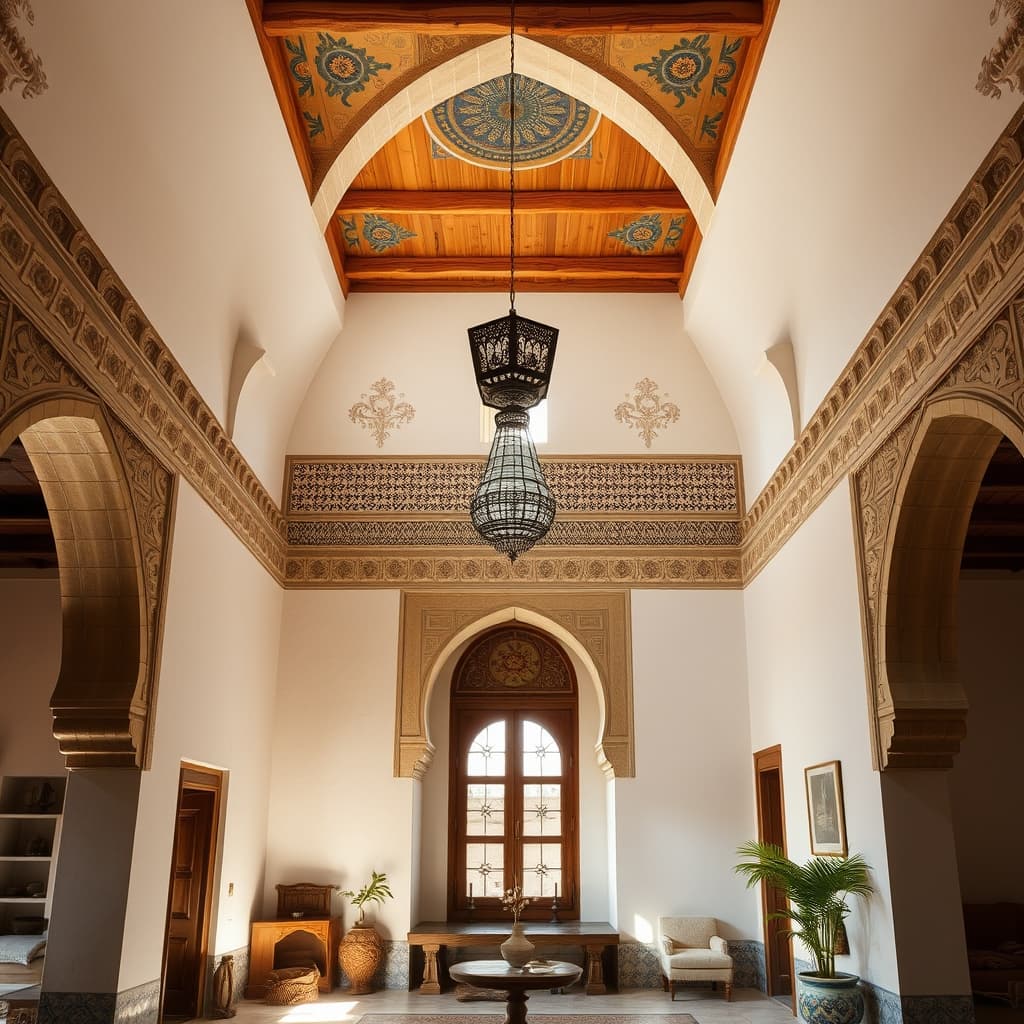
Riad wood restoration requires stabilizing historical architectural elements through precision joinery, moisture-controlled timber, and breathable protective finishes. Restoring carved cedar ceilings involves integrating Middle Atlas cedar (Cedrus atlantica) kiln-dried to 8%–10% moisture content, assembled using hand-pegged mortise & tenon joinery, and preserved with hand-rubbed natural Moroccan beeswax to ensure structural longevity.
Material Performance for International Climates
Selecting the appropriate timber species is foundational to successful riad restoration and architectural joinery. Historical North African interiors rely primarily on two native woods: Middle Atlas cedar (Cedrus atlantica) and Essaouira thuya (Tetraclinis articulata). Middle Atlas cedar contains natural aromatic oils that resist decay and insect infestation, making it the premier choice for expansive structural beams, ceiling coffers, and external fenestration. Conversely, Essaouira thuya offers dense, burled grain patterns best suited for decorative inlay, refined cabinetry, and targeted accent paneling.
| Timber Species | Botanical Name | Physical Characteristics | Primary Architectural Use |
|---|---|---|---|
| Middle Atlas Cedar | Cedrus atlantica | High dimensional stability, natural insect repellency, uniform fine grain | Monumental carved ceilings, structural beams, door leaves, fenestration |
| Essaouira Thuya | Tetraclinis articulata | High-density burl wood, rich figure, natural aromatic resin | Intricate marquetry, luxury tables, decorative door inserts |
Joinery and Kiln-Dried Moisture Practice
Historic architectural woodwork often fails when exposed to modern HVAC systems or transported across varied microclimates. At Art de Fès, timber is subjected to thermal conditioning until it reaches an 8%–10% kiln-dried moisture content. This targeted range prevents warping, checking, and joint separation in both arid desert environments and climate-controlled urban interiors.
Structural integrity is maintained through traditional hand-pegged mortise & tenon joinery. By avoiding rigid metallic fasteners, the wooden framework expands and contracts micro-seasonally without cracking. When executing comprehensive architectural woodwork, such as the Handcrafted Cedar Wood Arched Niche Window with Geometric Stained Glass and Monumental Carved Cedar Ceiling crafted for a historic site in Fes, Morocco, this mechanical joinery guarantees that complex architectural assemblies remain structurally sound across generations.
Installation and Modular Crating Logistics
Navigating the narrow pedestrian passages of historic medinas or shipping high-relief wood carving overseas requires rigorous logistical planning. Architectural ceilings and large-scale wall paneling are engineered into interconnected components at our Fes atelier before dispatch.
The installation workflow relies on structured preparation:
- Precision Engineering: Ceiling modules are test-assembled within the atelier to verify fit, structural alignment, and relief carving continuity.
- Numbered Modular Crating: Every panel, beam, and molding strip is assigned an alphanumeric code mapped to architectural shop drawings before placement in custom export crates.
- On-Site Assembly: Local installation teams or international contractors reassemble the interlocking modules using concealed mechanical joints and traditional wooden pegs.
Care and Beeswax Finishing for Longevity
Surface treatment determines how restored cedar ceilings age under ambient humidity and solar exposure. Synthetic polyurethane coatings trap residual moisture inside the wood fiber, leading to surface flaking and irreversible discoloration over time. In contrast, natural Moroccan beeswax provides a breathable, moisture-regulating barrier that highlights the natural depth of Middle Atlas cedar.
The finishing process involves applying warm, unrefined beeswax mixed with essential cedar oils, rubbed thoroughly into carved relief grooves, micro-carvings, and painted zouaq details. This treatment yields a soft satin patina, protects against airborne dust, and can be maintained through periodic buffing without stripping the underlying timber.
FAQ
Which timber performs best for humid vs arid rooms?
Middle Atlas cedar performs exceptionally well across both humid courtyards and arid indoor spaces due to its stable linear cell structure and natural oil density. For areas subject to ambient moisture, cedar remains superior to burl woods like thuya, which are better reserved for climate-stabilized interior accents.
How should architects specify moisture content for export?
Architects specifying timber for international projects should require an 8%–10% kiln-dried moisture content specification. This range ensures equilibrium moisture content (EMC) compatibility with standard North American and European interior heating and cooling environments.
What lead time should a bespoke order assume?
A bespoke order for a restored or custom-carved cedar ceiling typically requires a lead time of 10 to 16 weeks, depending on architectural scale, depth of relief carving, and timber kiln-drying cycles.