November 28, 2026
Painted Zouaq Ceilings in Atlas Cedar Joinery
Painted zouaq ceilings crafted from Middle Atlas cedar unite traditional joinery, mineral pigments, and modular fitting for global interiors.
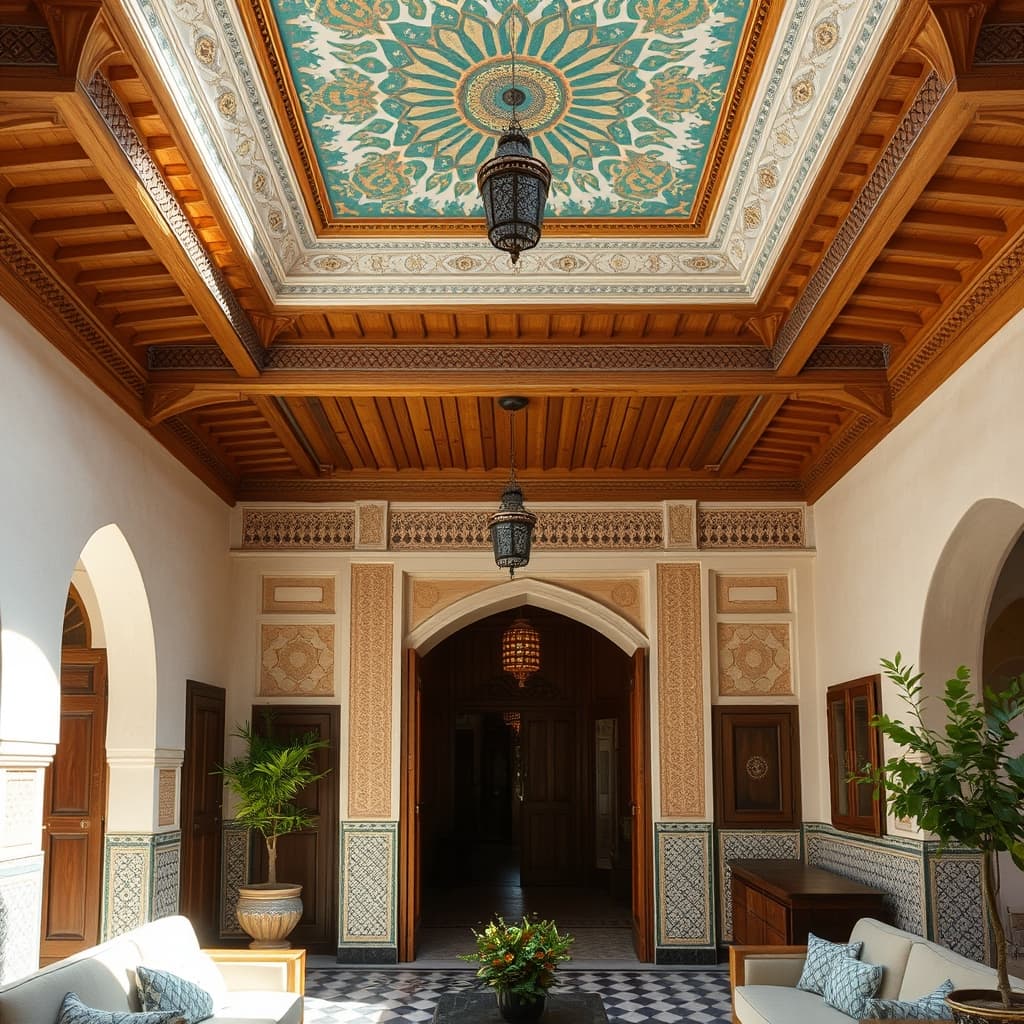
Painted zouaq ceilings executed on Middle Atlas cedar (Cedrus atlantica) combine structural woodcarving with polychromatic hand painting. Built using 8%–10% kiln-dried cedar and assembled via hand-pegged mortise & tenon joinery, these coffered installations are sealed with natural Moroccan beeswax and shipped via numbered modular crating for precise architectural integration.
Structural Timber Selection and Joinery Architecture
Architectural ceiling systems in traditional Moroccan interior design rely on stable, high-density woods capable of enduring environmental shifts without compromise. At Art de Fès, structural ceiling frameworks utilize sustainably harvested Middle Atlas cedar (Cedrus atlantica), valued for its natural insect resistance, fine grain, and aromatic character. For complementary interior elements requiring dense burl figures, craftsmen may integrate Essaouira thuya (Tetraclinis articulata), though Atlas cedar remains the primary substrate for large overhead spans due to its linear stability.
To ensure long-term dimensional integrity across international climate zones, raw timber undergoes controlled kiln drying until reaching an 8%–10% kiln-dried moisture content. This prevents post-installation contraction, expansion, or paint cleavage. Master carpenters execute structural framing using hand-pegged mortise & tenon joinery. By avoiding rigid metallic fasteners, the joinery accommodates subtle micro-movements in humidity while maintaining complete structural rigidity across broad coffered ceiling spans.
Mineral Pigments and the Craft of Zouaq
The application of painted zouaq requires precise geometry and mineral-based pigments applied directly over prepared wooden substrates. Historically developed in Fes and Marrakech, zouaq combines carved relief channels with flat geometric (tastir) or floral (tawriq) painted motifs. The timber surface is first planed, sanded, and primed with an organic gesso ground to form a smooth base for painting.
Artisans formulate paint layers using natural mineral pigments—including lapis lazuli blues, malachite greens, red ochres, and white lead substitutes—mixed with traditional binding mediums. Once the detailed paint layers are dry, master artisans protect the ceiling panels with hand-rubbed natural Moroccan beeswax. This organic sealant deepens color saturation, guards against moisture ingress, and yields a subtle matte finish consistent with historic Fassi architecture.
Technical Specifications: Cedar Zouaq Components
| Component Layer | Material Specification | Structural / Decorative Function |
|---|---|---|
| Primary Frame | Middle Atlas cedar (Cedrus atlantica) | Load-bearing grid joined via hand-pegged mortise & tenon joints. |
| Substrate Conditioning | 8%–10% kiln-dried moisture content | Stabilizes timber against warping, cracking, or pigment movement. |
| Pigment Layer | Mineral pigments in organic binder | Delivers precise geometric (tastir) and biomorphic (tawriq) patterns. |
| Protective Surface | Natural Moroccan beeswax | Seals pigment layers and provides a durable, breathable matte finish. |
Modular Prefabrication and Global Installation Workflow
Executing a bespoke order for an international ceiling installation requires seamless coordination between atelier pre-assembly and field execution. Because painted zouaq ceilings feature complex geometric interlocks, Art de Fès builds, paints, and pre-fits every system entirely within our Fes workshop before dispatch.
- Architectural Layout & Engineering: Ceiling dimensions are mapped to custom CAD templates, dividing the overall ceiling expanse into balanced structural modules.
- Wood Selection & Kiln Drying: Select Atlas cedar planks are dried to 8%–10% moisture content and milled to specification.
- Carving & Joinery Fabrication: Frames are shaped using hand-pegged mortise & tenon joinery to form interlocking recessed panels.
- Zouaq Hand-Painting: Painters execute mineral pigment patterns directly onto primed panel faces.
- Beeswax Sealing: Natural Moroccan beeswax is hand-rubbed into the finished wood and painted motifs.
- Atelier Dry-Fitting: The entire ceiling assembly is test-fitted on shop frames to verify joint alignment and pattern continuity.
- Numbered Modular Crating: Individual components are dissembled, tagged with sequential code identifiers, and packed in reinforced crates for safe global transport.
Upon arrival on site, local installation crews follow the sequential numbering layout, securing the pre-aligned modular components directly to the structural ceiling sub-frame with minimal job-site cutting.
FAQ
How does 8%–10% kiln-dried moisture content protect zouaq paint layers?
Wood naturally expands and contracts with changes in ambient humidity. By reducing the timber's moisture content to 8%–10% prior to carving and painting, structural movement is minimized, preventing the painted zouaq layer from cracking, flaking, or delaminating after installation.
Can painted zouaq ceilings be integrated into modern suspended ceiling frames?
Yes. Art de Fès engineers every bespoke order for compatibility with site-specific architecture. Sub-framing systems can be customized to mount directly onto concrete slabs, structural steel, or reinforced drywall furring grids using concealed structural hardware.
What maintenance is required for beeswax-sealed cedar ceilings?
Beeswax-sealed Atlas cedar ceilings require minimal maintenance. High-dust areas can be gently cleaned using a soft, dry micro-fiber cloth. Because the beeswax creates a breathable barrier, the paint remains protected from ambient moisture without peeling over time.